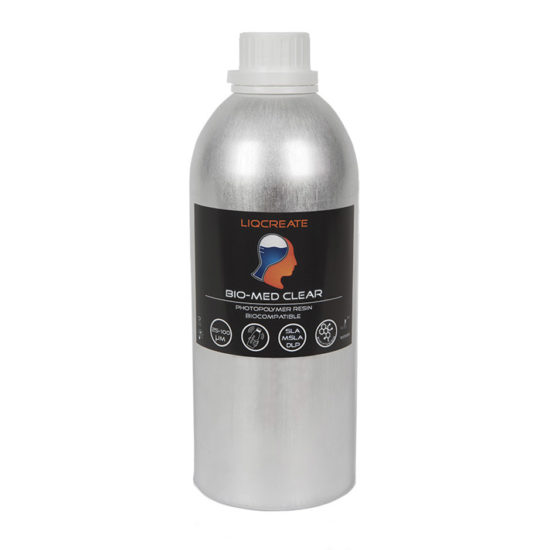
The Raise3D DF2+ is the updated model in the DF‑series resin platform and retains the same documented optical and mechanical specifications as the DF2, including a 2K DLP projection system, a 200 × 112 × 300 mm build volume, and a 405 nm wavelength. The DF2+ introduces workflow and hardware refinements such as improved resin circulation, enhanced temperature control, and updated mechanical components designed to increase printing stability and reduce maintenance. For validated settings on the original DF2, see the Liqcreate DF2 resin parameter page. For complete exposure settings across all Liqcreate materials, see the master resin parameter overview.
Raise3D provides validated material profiles for its own DF‑series resins, but the DF2+ also supports third‑party photopolymers through its open‑material mode. Raise3D and Liqcreate are partnering to optimze all Liqcreate resins and have them listed in the IdeaMaker slicing software. This will make the DF2+ compatible with a wide range of Liqcreate engineering, dental, casting, and functional resins.
Because Raise3D does not publish optical irradiance values, projector power curves, or power‑level mappings for the DF2 or DF2+, all parameter development for Liqcreate materials are based on empirical testing, cross‑printer comparison, and material‑specific curing characteristics. Liqcreate resins differ significantly in viscosity, absorption, filler content, and polymerization kinetics, meaning each resin requires its own optimized exposure settings and lift parameters when used on the DF2+.
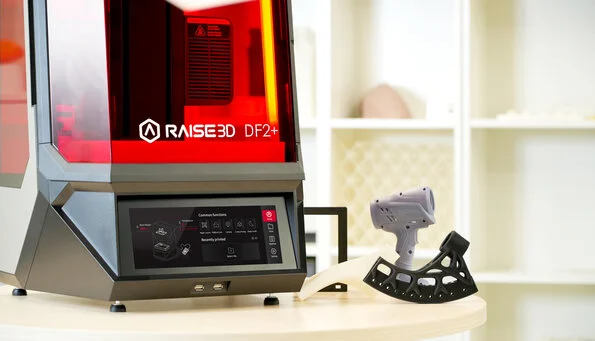
Liqcreate Resin Parameters for Raise3D DF2+
The Raise3D DF2+ supports third‑party photopolymers through its open‑material workflow, allowing full manual control over exposure settings, layer heights, lift speeds, and curing behavior. The settings below provide empirically confirmed starting points for printing Liqcreate engineering, dental, and functional materials on the DF2+, ensuring predictable curing, stable layer adhesion, and consistent dimensional accuracy across different resin chemistries. In time, Liqcreate resins will be added to the IdeaMaker slicer database. Contact us for imported profiles of the listed resins below.
| Resin Name | Layer Height | Bottom Layers | Bottom Exposure (s) | Normal Exposure (s) | Lift Speed (mm/s) | Retract Speed (mm/s) | Wait After Lift (s) | Notes |
| Bio‑Med Clear | 50 µm | 2 | 15 [Power 4] | 3.5 [Power 4] | 3 | 6 | 0.5–1.0 | Best accuracy at 50 µm; medium viscosity |
| Bio‑Med Clear | 100 µm | 2 | 30 [Power 4] | 6.0 [Power 4] | 3 | 6 | 0.5–1.0 | Faster build; ensure full cure depth |
Raise3D DF2+ Technical Overview
This section summarizes the documented technical characteristics of the DF2+ that influence resin behavior, curing consistency, and parameter development when operating in open‑material mode. Only specifications published by Raise3D are included to ensure accuracy and reproducibility.
Documented Hardware Specifications
Raise3D specifies the DF2+ as a 2K DLP system with a 2560 × 1440 projection engine and an XY pixel pitch of approximately 78 µm. The platform incorporates an industrial linear motion system, automated resin circulation, a heated vat, and closed‑loop control for layer formation. These components define the mechanical and thermal environment in which third‑party photopolymers must be tuned.
Build Volume, Resolution, and Wavelength
Supported layer heights range from 25 µm to 100 µm. The 405 nm wavelength is compatible with Liqcreate photopolymer chemistry and provides consistent polymerization when exposure parameters are correctly configured. These optical characteristics directly influence exposure depth, cure uniformity, and the achievable accuracy when tuning Liqcreate resin parameters for the DF2+.
Resin Handling and Temperature Control
Raise3D documents an integrated resin management system that includes automated circulation and controlled vat heating. These features maintain stable viscosity and flow behavior during printing, which is essential for medium‑ and high‑viscosity Liqcreate materials. Consistent resin temperature improves recoating uniformity and reduces variability in exposure response.
Open Material Mode and Third‑Party Resin Support
The DF2+ allows full manual control of exposure times, lift speeds, and layer parameters through its open‑material mode. Because Raise3D does not publish irradiance values or projector power mappings, all Liqcreate resin settings must be established through empirical testing. This open‑material workflow allows Liqcreate engineering, dental, and functional resins to be calibrated for consistent curing performance, even without published irradiance or projector power data. This calibration process ensures that each resin is matched to the DF2+ curing profile, accounting for differences in absorption, polymerization speed, and layer transition behavior.
Troubleshooting and Optimization
Effective troubleshooting on the Raise3D DF2+ requires understanding how resins respond to exposure, separation forces, resin viscosity, and layer transitions. The following sections outline the most relevant indicators and corrective strategies when optimizing Liqcreate resins on the DF2+.
Under‑Curing vs Over‑Curing Indicators
Under‑curing typically presents as soft surfaces, incomplete polymerization, loss of fine detail, or fragile features that deform during post‑processing. Heavy under-curing typically gives a structure similar to the skin of an orange. Over‑curing, by contrast, results in dimensional growth, loss of sharp edges, excessive fusion between supports and the model, or surface roughness caused by light bleed. Identifying these patterns allows exposure adjustments to be made in controlled increments, ensuring that each Liqcreate resin reaches the correct cure depth and maintains dimensional accuracy on the DF2+.
Support Strategy for Engineering Resins
Engineering‑grade Liqcreate resins require robust support structures due to their higher flexibility during peeling. Incorrect support density or contact size can lead to localized detachment, warping, or incomplete feature formation. Using reinforced support trees, larger contact points, and strategic placement on high‑stress regions improves print stability on the DF2+. Orientation adjustments can further reduce peel forces and enhance dimensional accuracy for functional components.
Tips for Filled and High‑Viscosity Resins
Filled and high‑viscosity Liqcreate materials—such as composite or ceramic‑reinforced formulations—benefit from slower lift speeds, longer wait times, and stable vat heating to ensure proper resin flow and recoating. These resins may require slightly higher exposure times to compensate for reduced light penetration caused by fillers. Maintaining consistent resin temperature and periodically mixing the vat during long prints helps prevent sedimentation and ensures uniform curing throughout the build.
With correctly optimized exposure settings, lift parameters, and resin handling conditions, the Raise3D DF2+ provides stable, repeatable performance across the full range of Liqcreate engineering, dental, and functional materials. Liqcreate continuously expands and validates resin profiles for the Raise3D DF2+. If a specific material is not yet listed or if additional tuning support is required, the Liqcreate technical team can assist with DF2+ parameter optimization. Contact: info@liqcreate.com.
Frequently Asked Questions
What exposure settings work best for Liqcreate resins on the Raise3D DF2+?
Exposure settings depend on resin viscosity, absorption, and filler content. The parameter table above provides validated starting points for each material, based on controlled testing in open‑material mode.
Why do Liqcreate resins require different settings on the DF2+?
Each Liqcreate resin has unique polymerization kinetics and optical absorption behavior. These differences affect cure depth, layer bonding, and separation forces, requiring resin‑specific exposure and lift parameters.
Will Liqcreate profiles be added to Raise3D IdeaMaker?
Yes. Raise3D and Liqcreate are actively validating materials for inclusion in the IdeaMaker slicer database. Until then, the settings on this page serve as the recommended starting profiles.
Support
Do you need any help with 3D printing our SLA, DLP or LCD resins? We can help you! Just look for the question you have below. If you can’t find it, let us know by contacting us!